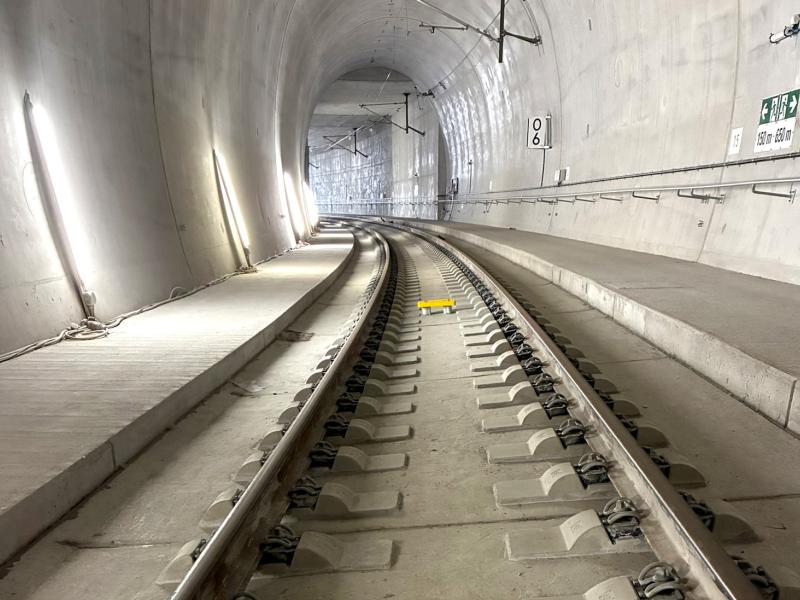
Resilient Railway Infrastructure
KliNa PROJECT of the MONTH 05/2026. How the Railway Sector Adapts to Climate Change.

Extreme weather events like heavy rain, landslides, heat waves or floods present increasing challenges for critical infrastructures. Climate change increasingly puts railway infrastructure under pressure: Damage at tracks, interruptions in operation or rising maintenance costs show that resilience becomes a central issue in future.
Martin Brandner (FCP) and Gerald Zwittnig (ÖBB) presented how resilience can be systematically established in the railway sector within the scope of Baukongress 2026 with their paper “Klima im Wandel: Maßnahmen zur Resilienzsteigerung der Eisenbahninfrastruktur” (Climate change: Measures for an increase in resilience of railway infrastructure).
The focus was on a practical approach to the adaptation of railway infrastructures to climate-induced risks – from the analysis of real damaging events to the implementation of specific protective measures.
Systematic Analysis of Climate Risks
On the basis of practical examples, the paper showed how resilient infrastructure is not established by individual measures but by structured and data-based risk management.
Above all there was a focus on the following steps:
- Analysis of real damaging events as a basis for further measures
- Identification of especially sensitive equipment within railway infrastructure
- Development and prioritization of well-aimed protective measures
- Integration of findings into rules and standards and planning processes
- Implementation of structural measures for a long-term increase in resilience
The presented approaches show that climate adaptation in the infrastructure sector must be increasingly considered in an interdisciplinary way – technically, economically and organizationally.
Data-Based Decisions for Resilient Railway Operation
A central lesson learnt from the paper: Resilience is not created by accident. Robust data, structured analyses and a strategic prioritization of investments are decisive.
The visitors of Baukongress profit from the following findings:
- Resilience is created by systematic risk management, not by individual measures
- Data-based analyses are the basis for economically reasonable investments
- The close cooperation of practitioners, infrastructure operators and researchers – among others also with the Vienna University of Technology – is decisive for sustainable solutions
Make Infrastructure Resilient
Resilience of critical infrastructure becomes more and more important with increasing climatic changes. Above all in the railway sector long-term strategies are required to ensure safety, availability and economic efficiency also under changed environmental conditions.
The paper at the Baukongress showed: Climate-friendly railway infrastructure is created where technical expertise, data-based design and interdisciplinary cooperation interact.